The governed AI portal for back-office teams

Your prompts, scripts, and agents as
one-click service items your whole team can run.

Every run governed, costed, and audited. AI results, not AI chats!

Supports:
  • Salesforce
  • HubSpot
  • NetSuite
  • QuickBooks
  • Xero
  • Maxio
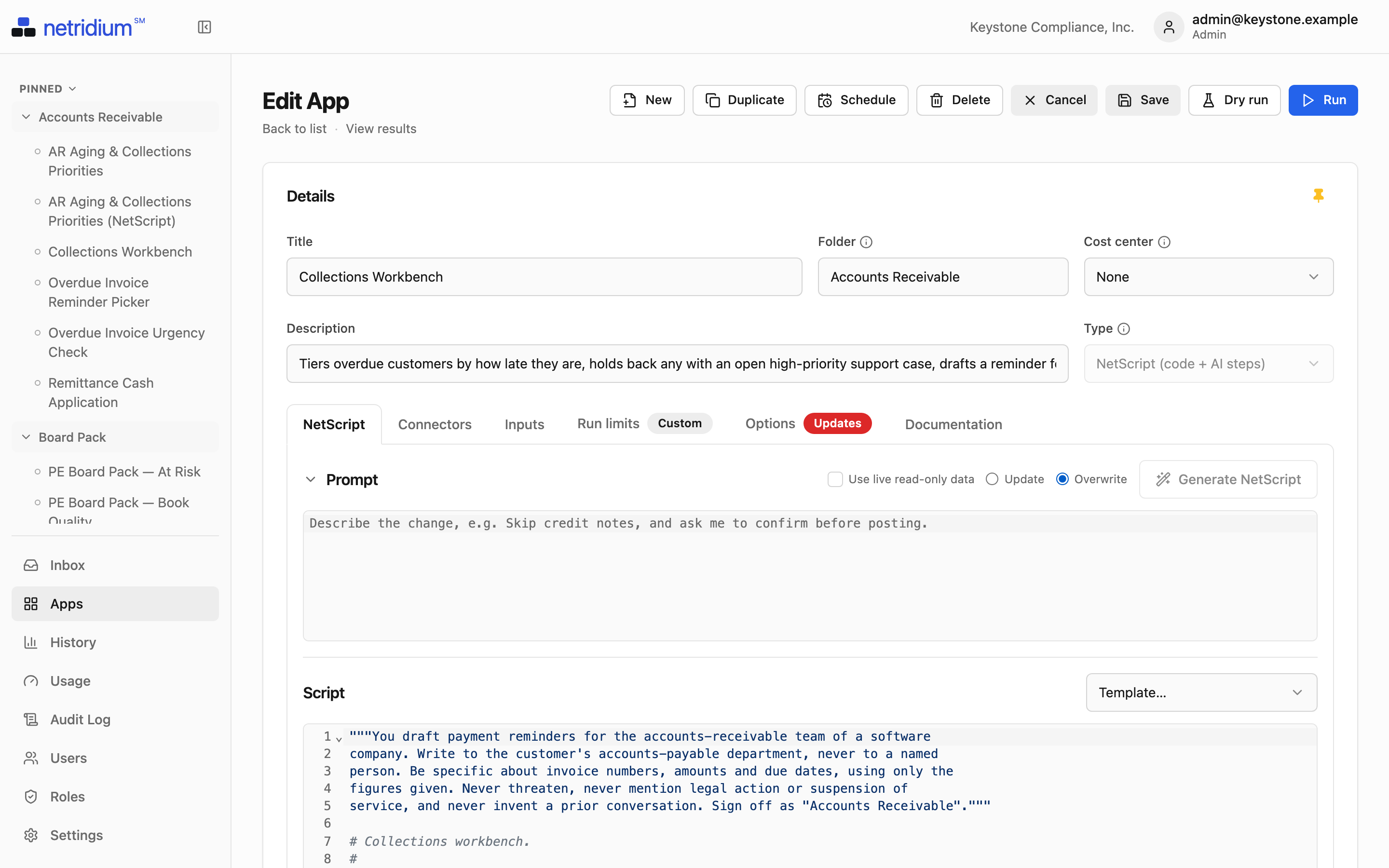
01 You author the prompt, script, or agent
netridium.com/build
# monthly-close-summary — you author it once
source QuickBooks, Xero
pull P&L, balances, AR aging
flag variances > 5%
output xlsx

02 Your team runs it as a service item
netridium.com/run
Monthly Close Summary
run · view results · never sees the prompt
Completed close_summary.xlsx · Jun 2026
Net revenue$482,100
Operating variance+6.2%
Flagged for review3 items
audited · cost center FIN‑100 · $0.04 charged back
Product

An AI service catalog and portal for your back office

IT staff, accountants, consultants, or MSPs author a prompt, script, or agent once, then publish it as a service item their users can just run — close, reconciliation, AR aging, revenue reporting. Users get results without touching prompts, credentials, or underlying systems: governed by default, costed per run, multi-tenant from day one. All through industry standard MCP.

Netridium — a QuickBooks Financial Health Snapshot report shown in the portal
A one-click service item returns a QuickBooks Financial Health Snapshot.
Netridium AI tools catalog — prompts, LSPL and scripts grouped by Xero, QuickBooks, Salesforce and Maxio connectors, each with View, Edit and Run actions
One catalog of service items — prompts, agents, LSPL and Python scripts across every connector — that your team runs with one click.
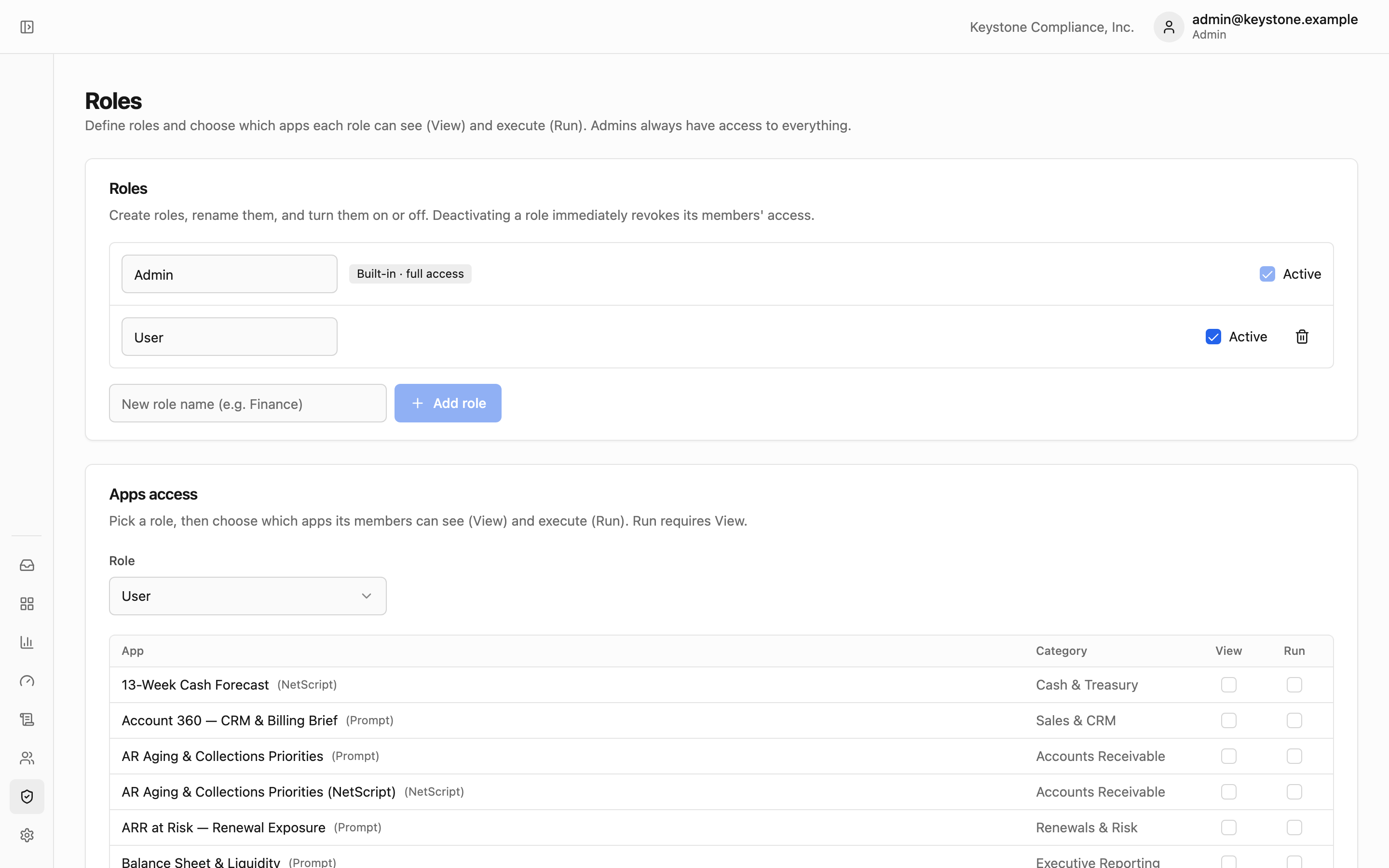
Netridium Roles screen — Admin, Finance, Sales and Contractor roles with a per-AI-tool matrix granting View and Run access
Role-based access — grant View and Run precisely, per AI tool, per role.

Built for the people who answer to auditors.

  • Role-based access
  • Budgets & cost centers
  • Chargeback to your GL
  • Full audit trail

No developers required.

Authoring

Author a service item three ways

Every service item shares the same plumbing — MCP connectors, the run queue, input forms, live status, budgets, audit, downloadable output. They differ in who owns the control flow.

Prompt / agent (natural language)

Describe the outcome.

Plain English. The model acts as the agent — it orchestrates your connectors, works out the steps, and picks the best output format. Fastest to author; supports model tiers and batch.

# Prompt — the agent owns the plan
List all active subscriptions grouped
by product, with MRR per group,
as an Excel sheet.
LogicScript Prompt Language (structured)

Write the steps; the AI runs them.

Full support for LSPL, executed in direct-execution mode — the AI reads each line and acts on it, reasoning at each AI.call, branching at each IF. Explicit and repeatable.

FUNC run(ticket)
  VALIDATE ticket.subject not empty
  DO
    c = AI.call("Classify this ticket")
    IF c.canResolve IS yes
      RETURN AI.call("Draft a reply")
    EMIT NeedsHuman { reason: "low conf." }
  RETURN "escalated"
Script (python)

Full deterministic control.

Python in a secure sandbox for exact calculations and logic the AI shouldn't improvise. Call connectors with mcp(...), reach for the model only where you want judgement, and emit(...).

rows = await mcp("Maxio").call(
    "advancedBillingShowCustomers",
    {"per_page": 20})
emit({"type": "excel",
  "sheets": [{"name": "Customers",
    "data": rows}]})

Prompt = "what I want," LSPL = "the steps to take," Script = "exactly how to do it." Whichever you pick, it publishes as the same one-click service item — same permissions, same budgets, same audit record. Don't want to start from scratch? Describe what you want and the portal generates a runnable script using the real tools your connectors expose — so tool names and parameters are correct, not guessed.

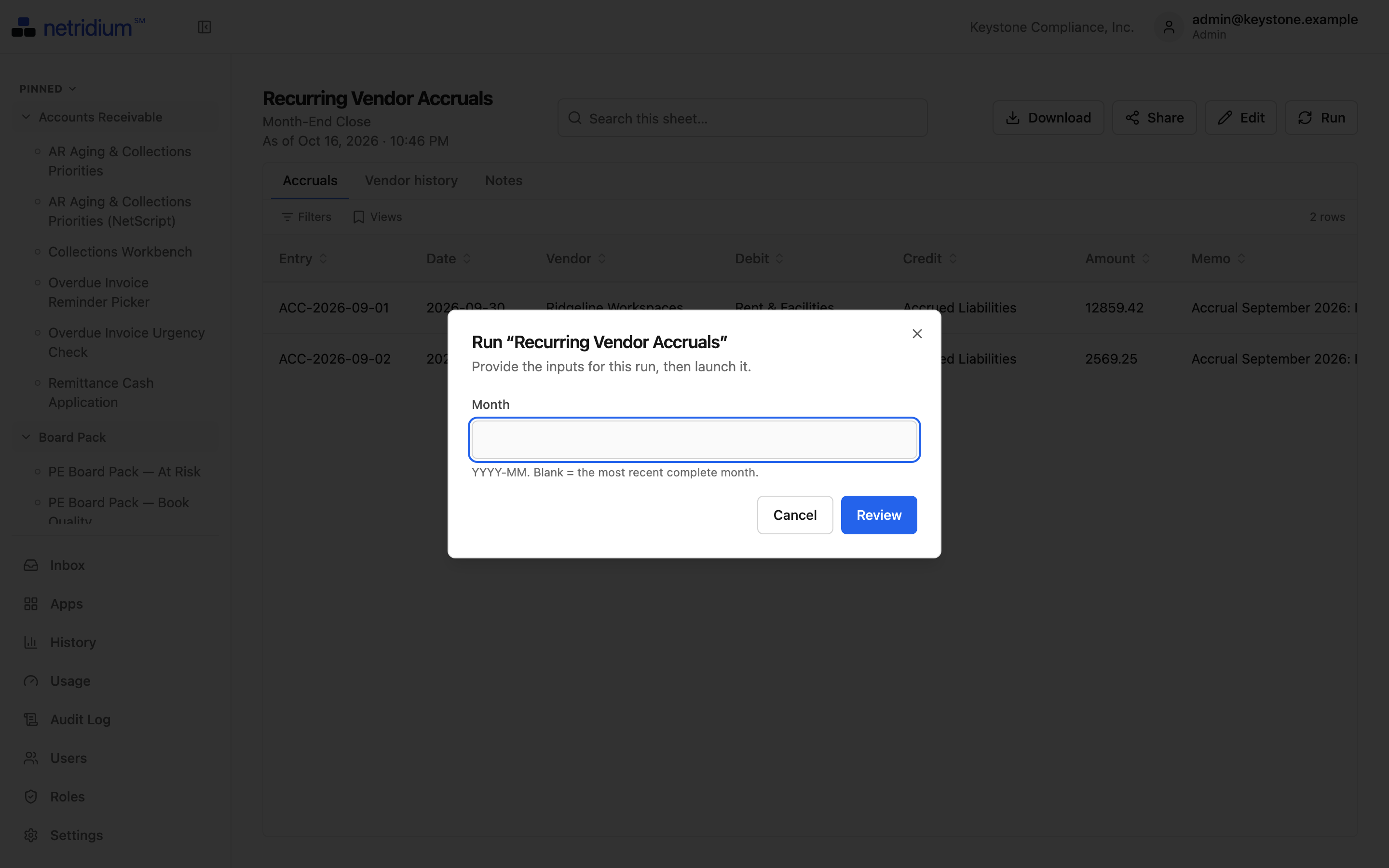
Parameterized tools

Add a form. Make it self-service.

Declare a few inputs and one service item serves many cases. The user fills a short form up front; the values are validated, then woven into the run. No prompt editing, no guesswork.

Field types
Text Number Yes / No Date Dropdown
In the script body, reference a value as {{key}}
Reconcile account(s) {{accounts}} for the
period {{period_start}} to {{period_end}}.
Flag mismatches; return a status + comments.

## Inputs provided for this run
- accounts: 1000, 1200, 2050
- period_start: 2026-05-01
- include_notes: true

Every value is also appended as a labelled block — a safety net so the model sees it even without a placeholder. Validated in the dialog and again on the server.

How it works

Build → Publish → Run

The builder / consumer split: the person who authors a capability is not the person who runs it. Build once; publish it as a service item; let everyone run it safely — governed, costed, and audited every time.

01 · Build

Author against your systems.

IT, consultants, and accountants build a prompt, agent, LSPL script, or Python — pick the connectors it may use, add inputs, set the output, set the budget. Save before you run, so what executes is the saved version.

# close_summary · type: lspl
connectors:  QuickBooks, Xero
inputs:      period (date)
access:      read-only
budget:      $0.25 / run
costcenter:  FIN-100
output:      xlsx
02 · Publish

Grant View and Run, per service item.

Roles control who can see a service item versus who can run it. Publish to one workspace or every client tenant — and revoke or change it for everyone at once.

close_summary acme-corp globex initech +12
can build can run can see (run only)
03 · Run

End users just click run.

Fill the form, click Run, get a finished report. Every run is asynchronous, recorded in the audit log, costed to a cost center, and replayable — and notifies whoever needs it.

Ready in 4.2s
[14:02:11] auth: alice@acme · role=runner
[14:02:11] input: period=2026-05
[14:02:15] output: close_summary.xlsx · 3 flags
[14:02:15] audit: recorded · cost $0.04 → FIN-100
Builders

IT, consultants, accountants & MSPs

Build tools against deep domain knowledge, wire up connectors, add input forms, test, version, and publish — from one console.

  • Prompt, agent, LSPL, or Python — your choice per service item
  • Generate a runnable script from a description — no developers required
  • Export / import service items as portable files between workspaces
Runners

Your whole team

No technical knowledge needed. Open My Reports, search the catalog, fill a short form, and click Run — a finished report comes back, every time.

  • One click → a result; never see the prompt
  • Live status that survives navigating away
  • Searchable results with links back to the source system
Connectors

Connected to your systems of record

Depth over breadth — back-office finance and operations done exceptionally well. Each workspace connects its own accounts over MCP; credentials are encrypted and never shared across tenants.

One-click OAuth — connect & authorize, no API keys
Salesforce Xero QuickBooks Online
Add a connector — OAuth or a service URL / token
Google Drive · OAuth Maxio · MCP URL + OAuth NetSuite · MCP URL + token

Read-only by default; write access granted explicitly, per connector. Roadmap: Microsoft 365, HubSpot, and more.

AI economics

Costed per run. Charged back to your GL.

AI spend that finance can actually account for. Every run carries a budget before it starts and a cost after it ends — attributed to the user, the service item, and the cost center that asked for it.

Chargeback — June 2026 ready to post
Cost center GL account Runs Amount
FIN-100 · Accounting 6820 412 $318.40
SLS-220 · Sales Ops 6820 186 $142.75
OPS-310 · Supply Chain 6825 97 $74.10
Total charged back 695 $535.25
Export to CSV · every line traces to a run in the audit log
What finance gets
  • Budgets and fail-closed caps per run, per service item, per workspace
  • Cost centers assigned at publish time — the runner never picks the code
  • Chargeback lines that reconcile to your GL accounts
  • Per-tenant rollups for service providers rebilling clients
  • BYOK on Enterprise — run on your own provider key and keep the spend in your contract

Model tiers and batch mode cut the bill before it's ever incurred: route simple jobs to a fast model, run non-urgent work in batch at roughly half the cost.

Governance, security & trust

Governance isn't a feature. It's the product.

Built for the people who answer to auditors — the reason to choose a governed portal over handing staff raw ChatGPT or Claude logins.

Role-based access control

Grant View and Run precisely, per AI tool. Invite users by email with optional approval, assign roles, and publish a capability to exactly the right people.

Complete audit trail

Who ran what against which data, every connector call, every admin change — all recorded, with the cost and cost center on every line. You always know who did what, and what it cost.

Read-only by default

Connectors are read-only out of the box. Write access is granted explicitly, per connector — a tool can never change data through a connector that isn't write-enabled.

Secret-less sandboxed execution

Python runs in an isolated sandbox with no access to platform secrets. A trusted broker injects credentials per call and tears them down when the run ends — tools never hold your keys.

Multi-tenant isolation by design

Every workspace's data, connectors, tools, and results are isolated at the database level and never cross into another — the same guarantee that powers the channel model.

Budgets, cost centers & allow-listing

Per-run token and call budgets with fail-closed enforcement, so a runaway job can't loop forever or run up a bill. Spend lands on a cost center; only approved models can be used.

Platform

One platform, from author to one click

Build a capability once against your systems of record. Publish it as a service item to exactly the right people. One click and they get a finished report back.

Self-service input forms

Add a short form to any service item — Text, Number, Yes/No, Date, or Dropdown. Users pick a date range or an account and click Run. Inputs are validated before the run ever starts.

Systems of record, connected

NetSuite, Salesforce, Maxio, QuickBooks Online, Xero, and Google Drive over the Model Context Protocol. Each workspace connects its own accounts — credentials never cross tenants.

Results that fit the work

Excel (multi-tab, searchable), formatted HTML, print-ready PDF, charts, plain text, or JSON. Record IDs link straight back to the source system; download with one click.

Run now, or on a schedule

Run on demand, or automatically — daily, weekly, or monthly in the timezone you choose. Scheduled runs land in History with a badge and notify the right people.

Live status & full history

Runs are asynchronous: Queued → Running → Ready (or Failed). Status follows you across the app. History keeps every run's inputs, result, and cost — re-open, re-run, or cancel.

Share results, safely

Share a finished report through a secure link that opens an access-controlled viewer — never a raw file. Optional email notifications fire when a run finishes or fails.

Book a live demo.

See how Netridium publishes your prompts, scripts, and agents as governed service items your whole team can run — costed and audited on every run. Tell us a bit about you and we'll be in touch.